Diátaxis
Sunday, February 8, 2026 AI
https://x.com/threepointone/status/2020424644319404388
Free alpha for you, a thing you can do _today_. Point your docs at the Diátaxis framework , ask your coding agent its opinions, and rewrite it.
Learnt this from @ghostwriternr. It’s excellent. Been rewriting agents docs with this.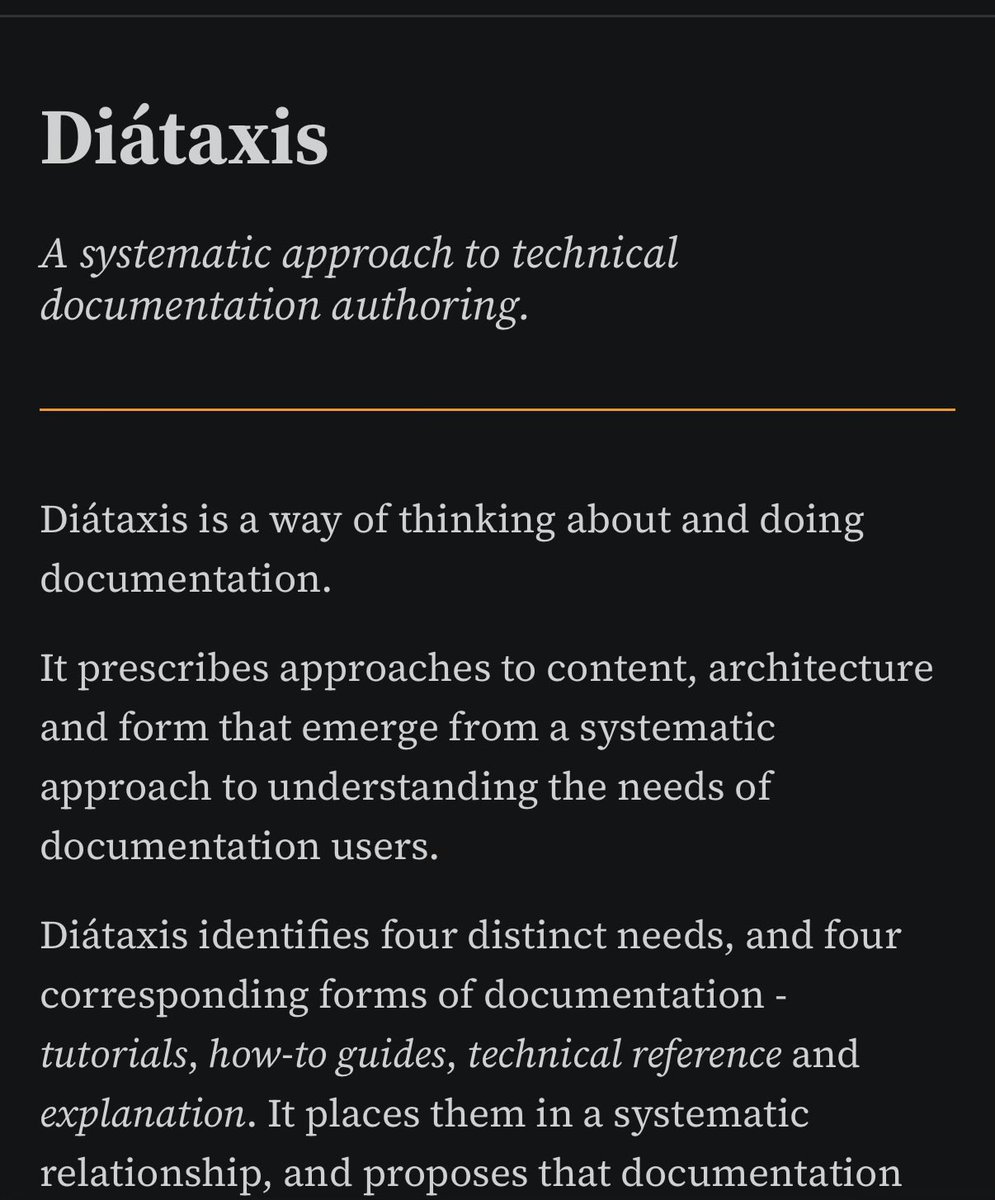 Feb 8, 2026 View on X →
Scraped Article
ContentsMenuExpandLight modeDark modeAuto light/dark mode
[Back to top](https://diataxis.fr/#)
Toggle Light / Dark / Auto color theme
Toggle table of contents sidebar
# Diátaxis [¶](https://diataxis.fr/\#diataxis "Link to this heading")
A systematic approach to technical documentation authoring.
* * *
Diátaxis is a way of thinking about and doing documentation.
It prescribes approaches to content, architecture and form that emerge from a systematic approach to understanding the needs of documentation users.
Diátaxis identifies four distinct needs, and four corresponding forms of documentation - _tutorials_, _how-to guides_, _technical reference_ and _explanation_. It places them in a systematic relationship, and proposes that documentation should itself be organised around the structures of those needs.

Diátaxis solves problems related to documentation _content_ (what to write), _style_ (how to write it) and _architecture_ (how to organise it).
As well as serving the users of documentation, Diátaxis has value for documentation creators and maintainers. It is light-weight, easy to grasp and straightforward to apply. It doesn’t impose implementation constraints. It brings an active principle of quality to documentation that helps maintainers think effectively about their own work.
* * *
## Contents [¶](https://diataxis.fr/\#contents "Link to this heading")
The best way to get started with Diátaxis is by applying it after reading a brief primer.
- [Start here](https://diataxis.fr/start-here/)
These pages will help make immediate, concrete sense of the approach.
- [Applying Diátaxis](https://diataxis.fr/application/)
- [Tutorials](https://diataxis.fr/tutorials/)
- [How-to guides](https://diataxis.fr/how-to-guides/)
- [Reference](https://diataxis.fr/reference/)
- [Explanation](https://diataxis.fr/explanation/)
- [The compass](https://diataxis.fr/compass/)
- [Workflow](https://diataxis.fr/how-to-use-diataxis/)
This section explores the theory and principles of Diátaxis more deeply, and sets forth the understanding of needs that underpin it.
- [Understanding Diátaxis](https://diataxis.fr/theory/)
- [Foundations](https://diataxis.fr/foundations/)
- [The map](https://diataxis.fr/map/)
- [Quality](https://diataxis.fr/quality/)
- [Tutorials and how-to guides](https://diataxis.fr/tutorials-how-to/)
- [Reference and explanation](https://diataxis.fr/reference-explanation/)
- [Complex hierarchies](https://diataxis.fr/complex-hierarchies/)
* * *
Diátaxis is proven in practice. Its principles have been adopted successfully in hundreds of documentation projects.
> Diátaxis has allowed us to build a high-quality set of internal documentation that our users love, and our contributors love adding to.
>
> —Greg Frileux, [Vonage](https://vonage.com/)
> At Gatsby we recently reorganized our open-source documentation, and the Diátaxis framework was our go-to resource
> throughout the project. The four quadrants helped us prioritize the user’s goal for each type of documentation. By
> restructuring our documentation around the Diátaxis framework, we made it easier for users to discover the
> resources that they need when they need them.
>
> — [Megan Sullivan](https://hachyderm.io/@meganesulli)
> While redesigning the [Cloudflare developer docs](https://developers.cloudflare.com/), Diátaxis became our north star for information architecture. When we weren’t sure where a new piece of content should fit in, we’d consult the framework. Our documentation is now clearer than it’s ever been, both for readers and contributors.
>
> — [Adam Schwartz](https://github.com/adamschwartz)
Downloads[PDF](https://diataxis.fr/_/downloads/en/latest/pdf/)On Read the Docs[Project Home](https://app.readthedocs.org/projects/documentation-system/?utm_source=documentation-system&utm_content=flyout)[Builds](https://app.readthedocs.org/projects/documentation-system/builds/?utm_source=documentation-system&utm_content=flyout)Search
* * *
[Addons documentation](https://docs.readthedocs.io/page/addons.html?utm_source=documentation-system&utm_content=flyout) ― Hosted by
[Read the Docs](https://about.readthedocs.com/?utm_source=documentation-system&utm_content=flyout)